Biting Back On Burnout
How The Burnt Chef Project’s Canadian build-out—and a smart, branded burger—are making mental health a year-round conversation in hospitality.
Mental health, as a subject of public conversation, has travelled a remarkable distance in a remarkably short time. What was once raised only in whispers is now embedded in corporate reporting, workplace legislation, benefits design, and the everyday vocabulary of how organizations describe themselves to prospective employees. Mental Health Awareness Month, observed across much of the world this May, has been one of the engines of that shift.
The economic case for action is mounting in step with the human one. A Canadian Standards Association (CSA) report released this spring estimated the annual economic burden of mental health challenges in Canada at $180 billion—more than triple the figure from 2011—with employers shouldering more than $110 billion of that total in lost productivity, disability leave, and workplace accommodations. Eighty-six per cent of employer spending in this area, the report found, goes toward reactive measures after harm has already occurred and just 14 per cent is directed at prevention and early intervention. The imbalance is structural, not moral, and it is precisely the gap that the restaurant industry and groups like The Burnt Chef Project, a non-profit social enterprise founded in the UK in 2019 by Kris Hall and run to raise awareness, provide support and education around mental health and mental health issues within hospitality, are hoping to help close.
The essential work of closing that gap is driven by demographics, and it’s urgent. Forty-one per cent of the culinary workforce is under 25, the cohort Statistics Canada identifies as the highest-risk population-wide for mental health challenges, and the demand curve is moving with them: from 2017 to 2025, according to Beneva’s 2026 Connecting the Dots report, the number of young insured Canadians aged 18 to 30 consulting a mental health professional doubled, climbing at roughly nine per cent annually. Sector-specific data tracks the same trajectory. Toronto-based non-profit Not 9 to 5, in its 2021 pan-Canadian Mind Your Health survey, reported burnout among 87 per cent of front-line hospitality workers and depression among 77 per cent, with two-thirds of respondents saying they kept their struggles hidden. Set those figures against the fact that more Canadians have their first job in a restaurant than in any other industry, and the case for investing in support infrastructure becomes a recruitment, retention, and leadership development imperative.
That responsibility is one the sector increasingly recognizes and prioritizes. Restaurants Canada, as the national association representing the country’s foodservice industry, frames mental health as inseparable from the health of the industry itself—a sector that employs roughly 1.2 million people, stands as Canada’s fourth-largest private-sector employer, and serves as the single largest source of first jobs in the country. “Our industry is the first workplace for more Canadians than any other, and that comes with real responsibility,” says Kelly Higginson, Restaurants Canada’s President and CEO. “That scale carries a particular weight, as for a great many Canadians, restaurants are where they first learn what a workplace can be, and the managers and colleagues around them are often the first line of support when life outside the job becomes difficult. It is a role the industry takes seriously, and one it continues to build on, looking for new ways to deepen the impact of its work in this space, both for the people who power the sector and for the communities they serve. Restaurants Canada is proud to stand behind initiatives that give operators practical tools to care for their teams, and we’ll keep looking for ways to make mental health a lasting part of how this industry operates.”
The Burnt Chef Project

Rob Hood, Corporate Director of Food & Beverage at Silver Hotel Group and Canadian Ambassador for The Burnt Chef Project, describes young workers as better informed, more decisive, and considerably less inclined to absorb personal and professional costs in silence. They are also doing their homework: a prospective employee can easily audit a company’s culture, reviews, and stated values in a single afternoon online, and the next generation, Hood notes, is “very smart” about distinguishing substance from spin.
Few organizations have done more to translate demand into practical tools than The Burnt Chef Project. Founded in May 2019 by Kris Hall, then a sales professional working with fine-dining restaurants in the south of England, Burnt Chef began as a black-and-white photography campaign and a small line of merchandise that funded a first round of mental health training. Today, it operates in more than 100 countries and nine languages, offering free 24/7 support, accredited training, peer ambassador networks, original industry research, and the free e-learning
modules via The Burnt Chef Academy. Their work is deliberately practical, focusing on awareness, recognition, early intervention, and access—the language and pathways that managers and frontline staff need before anyone reaches a point of crisis.
That ethos is now being formalized on Canadian soil. After roughly two years of advocacy and proof-of-concept work led by Tom Mitchell, Burnt Chef’s Canadian Chief Ambassador and President for North America, the organization is devolving Canadian management to the Canadian team, with national non-profit infrastructure being stood up to facilitate. Where the U.K. presence is associated with marquee fundraising from Kilimanjaro climbs to ultra-distance walks, the Canadian programme is starting closer to the ground. “What we need right now is people going for coffee,” Mitchell says. “People sitting down at the table and talking about the issues and the problems.”
The Burnt Chef Burger Project


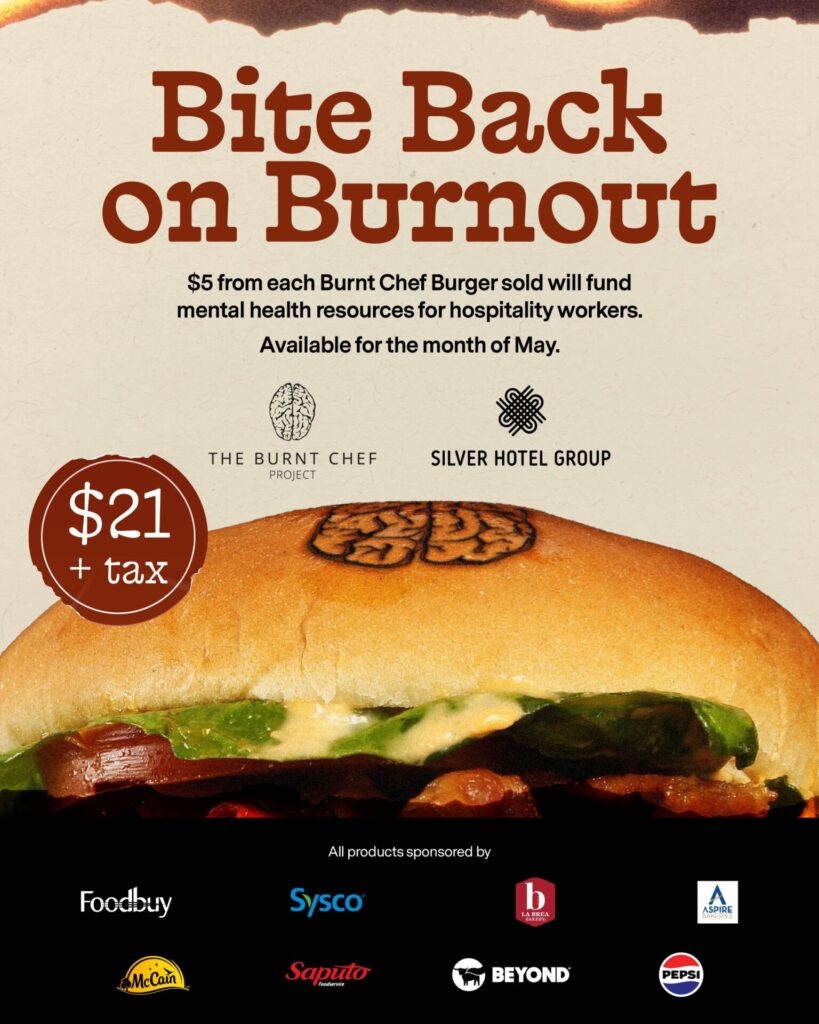
Throughout May, the most visible expression of that work is on the menu at Silver Hotel Group restaurants from downtown Toronto to Thunder Bay, where a branded, signature dish—The Burnt Chef Burger—is doing more than feeding guests. Silver Hotel Group is the first Canadian hotel management company to mount a multi-property campaign, “Bite Back on Burnout” with The Burnt Chef Project, and guests are invited to “fuel the industry that feeds you” by ordering the limited-time-only cheeseburger. Available in both traditional and Beyond Meat formats, the burger is served on a bun seared with the Project’s logo, courtesy of a custom branding iron.
“It’s a great burger and beverage package for $21, and $5 from every sale goes to The Burnt Chef Project North America to provide free mental health resources,” Hood explains. “This is a major fundraising initiative to couple mental health awareness with fundraising, to keep The Burnt Chef machine operating and our resources free.”
It is also the first activation of its kind in Canada. “We want to make it a success in two ways,” Hood says. “We want to raise money, and we want to develop the prototype to grow the impact by bringing in new locations to do it nationally in 2027.” Mitchell conservatively projects sales of 1,200 burger packages this May, raising approximately $6,000 in year one, a deliberately attainable target designed to prove the model and grow the community of participating restaurants and vendors for a second-year expansion.
What makes the growth plan realistic is the architecture of the Canadian pilot with the Silver Hotel Group. National vendor partners—Sysco, Foodbuy, Saputo, LaBrea, Aspire, Beyond Meat, McCain, and Pepsi—have donated their products into the program build, so the $5 donation per burger flows from the sale itself, leaving the operator margin intact and labour and cost-of-sales lines unaffected. “The brilliance of the business model is that we’re not taking money off the top,” Hood says. “It’s efficient, and we’re not penalizing participating restaurants. Everyone has to make their revenue and profit, and the fact that the vendors are donating the product returns value for everybody. We’re working together with suppliers toward the same goal.” Hood also emphasizes that, when he first put the question to those partners, their response was immediate and enthusiastic. “They didn’t hesitate, and they’re ready to grow with us.”
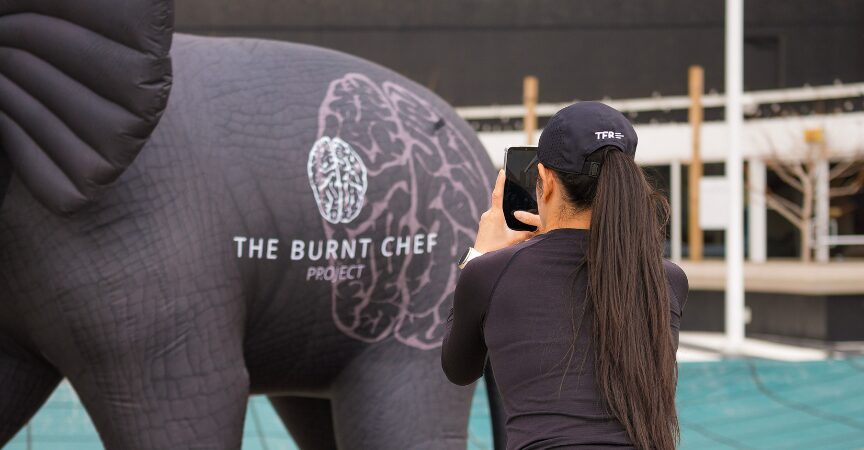
The campaign launched on April 29 with a Food Runners 5K run through downtown Toronto, beginning at Radisson Blu Toronto Downtown and concluding at Novotel Toronto Centre, where finishers were the first guests to experience the burger. The Food Runners are a Toronto-based running crew founded by Back of House creator Chuck Ortiz, built specifically for hospitality professionals seeking better work-life balance, stronger mental health, and a community that understands the rhythms of the trade, making for a seamless and natural collaboration.
The marketing build for the campaign has matched the thoughtfulness of the operational concept, with Emily Justice, Senior Marketing Manager at Silver Hotel Group, developing and shepherding a multi-channel rollout. “We announced the initiative the second week of April, sending out a press release and going live on Silver Hotel Group’s Instagram, collaborating with The Burnt Chef Project and the campaign vendor partners,” she says. “Overall, it’s been our top-performing post over the last month, quickly reaching 25,000 users across Silver Hotel Group social media channels, and still growing.” Each participating property has activated its own channels in support, from tent cards on dining tables featuring a QR code linking guests directly to The Burnt Chef Project, to digital posters running on hotel screens and in elevators. The intent, Hood notes, is to make the campaign work in two directions at once, funding free industry resources from the inside, and inviting guests in from the outside to take part.
“The hospitality industry is built on service,” he observes, “but often those behind the scenes are the ones who need serving the most.”
The 2027 invitation
The burger, in this sense, is a vehicle for building a national community of operators, suppliers, and frontline professionals, organized around the conviction that culture is now the industry’s single most important recruitment, retention, and community-building instrument—an ambition with few barriers to entry. The Burnt Chef Canadian team has built the 2027 expansion to be genuinely operator-friendly: a complete business case and financial kit available to any business that wants to take part, plus introductions to the participating national vendors. “It’s a really simple principle,” Hood says. “Whether you’re running a restaurant or a hotdog stand, you’ll be able to run this and scale it to what your business can afford.”
Mitchell, characteristically, takes the geography further still. “We have a scalable platform for anybody who wants to get involved. If someone in Grande Prairie, Alberta, or Brandon, Manitoba, wants to do this, we can make that work.”
Operators interested in joining the 2027 cohort, or in being added to The Burnt Chef Project’s broader Canadian community outreach roster, are invited to make contact directly to express their interest. Joining costs nothing, and participation can begin at whatever scale a business can sustainably support. “Everybody’s invited, welcome, and equal to participate in this initiative,” Mitchell says. “This is an idea that can grow and expand beyond this pilot and make mental health part of the conversation year-round.”
Hospitality has always been an industry that takes care of people. The campaign on this month’s menu is a chance to extend that same care to the people whose business is caring for others, and to enjoy a great burger while doing it. Stop by a participating restaurant and order The Burnt Chef Burger, get on the list for 2027, and be part of a year-round conversation that’s only getting bigger.
Bite Back on Burnout
Get The Burnt Chef Burger until the end of May. The Burnt Chef Burger is available at Cafe Nicole Bistro (Novotel Toronto Centre), Mossop’s Social House (Hotel Victoria), Humble Donkey (Union Hotel), Constantine Restaurant(The Anndore House), and Stages Restaurant & Lounge (Pantages Hotel) in downtown Toronto; at Dixon Kitchen + Bar (Hilton Garden Inn Toronto Airport–Mississauga) and W XYZ Bar (Aloft Vaughan Mills) in the Greater Toronto Area; and at Skal Restaurant (Valhalla Hotel & Conference Centre) in Thunder Bay.
Get on the list for 2027. To express interest in joining The Burnt Chef Project’s 2027 Canadian community outreach list, request the campaign business case, or learn more about hosting The Burnt Chef Burger at your venue, send an email to: info@theburntchefprojectcanada.com, quoting “The Burnt Chef Burger” in the subject line.

For immediate support in Canada, the Burnt Chef Freephone Support line is available at 877-847-4525, with response times of approximately two minutes. Free e-learning modules are available through The Burnt Chef Academy.