
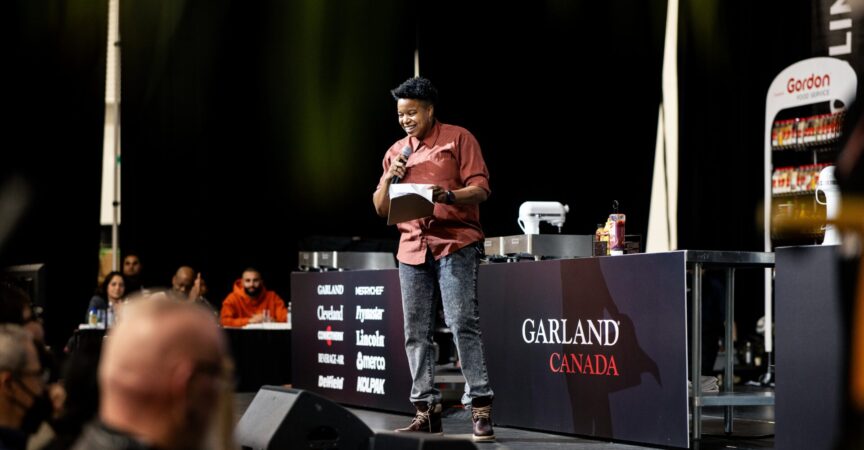
Just Go for It.
Chef Marissa Leon-John on Fear, Self-Worth & Building a Life You Love
Self-taught Montreal-based chef and entrepreneur Marissa Leon-John is best known today as a MasterChef Canada alum, private chef and founder of Elle Jay’s private dining and Fairy Dust spice blends. But for most of her life, she never pictured herself working in foodservice at all. “I love to eat,” she says, “and I grew up in a family full of folks who were great cooks.” Some of her core childhood memories are of Thanksgiving and Christmas dinners, sneaking into the kitchen for bites from her grandmother or aunts “who were whipping up the most delicious foods for us.”
Food, for Leon-John, was how people showed love and told stories. “I’ve had a deep connection with food as a way of showing love and togetherness and connection,” she says. She also grew up with a very different model of kitchen leadership than the stereotypical screaming chef. “I literally grew up in homes where it was Black women running the show. And everyone was asking them for all the tips and the tricks, so that’s what I bring to the table.”
For years though, nothing about her resumé pointed to a future in the foodservice industry. “I worked for the Bank of Montreal for five years. I worked for Stingray Music for five years. Before that I was an army reservist,” she says. “There was no way to have predicted I would end up here.”
At the music company where she worked, staff often brought food to share. At the end of each potluck, Leon-John noticed a pattern. “My dishes were always empty—mine and one other colleague’s in particular,” she says. “My colleague was obsessed with MasterChef but didn’t want to apply alone and asked me to go with her. So, we did that and I got on the show. And really, it was a fluke that took off from there.”
Leon-John admits she went in cold. “I hadn’t watched the show before. I went in with zero expectations, and not much fear,” she says. “It was just like a kind of cool adventure that I was about to take… and it went really well. I work well under pressure.”
Back in Montreal, there were about eight months between filming and airing. She couldn’t reveal where she’d been, but she knew she didn’t want to go back to being just the person who brought the best dish to the office party. “I found myself chasing the dragon,” she says. “I wanted to feel that. I wanted to feed people. I had a few friends who took a chance on me. I cooked for their dinner parties and birthdays, and it kind of just snowballed from there. There have been a few bumps along the way, but it’s been really good.”
The decision to walk away from a secure nine-to-five was one of those bumps. “It was a really, really tough decision because I was very comfortable,” Leon-John acknowledges. “I liked my job a lot and it was stable. It was secure. I had a great paycheck every two weeks. There was nothing wrong with it minus the excitement—I wasn’t passionate about what I was doing.”
She took time to reflect and talked it through with her parents, and their initial skepticism fuelled her resolve. “They thought I was crazy,” she says, laughing. “As the firstborn daughter, I just had to just carve my own path. I decided to jump in with both feet and go for it.”
Leon-John’s successful private dining and events brand, Elle Jay’s, grew directly out of those first post-show bookings. “Elle Jay’s was definitely born from my experience on MasterChef and going into people’s homes or doing corporate events and cooking for people,” she says, but despite her courage, she was not immune to self-doubt. “I didn’t go to culinary school, nor did I come up in restaurants,” she says. “I was on a reality cooking competition as a home cook. And I still see myself as a very, very good home cook who gets thrown into chef-like experiences. I do not feel like an imposter. I know that I can show up in pretty much any kitchen and hold my own. I’m happy to learn from those seasoned chefs and they learn things from me, like how to be chill.”
Like most entrepreneurs, Leon-John has endured swings in both opportunity and fortune. “Covid was a disaster,” she says. “I was just starting to feel established and like, I was booking clients six months in advance and then, all of a sudden, we’re not allowed to leave our homes. Then, there was a devastating fire and I lost everything. I had folks who stepped in to scoop me up. People found a reason to book me because they wanted to help me get back on my feet. I got to see what kind of community I built through my brand, through being myself, through being genuine. We’re not quite there yet, but we’re getting closer.”
During Covid, she joined a food business incubator with DESTA, a Montreal-based non-profit serving the Black community, focusing on education, employability and entrepreneurship. “Over the course of eight or nine months I went through kind of like entrepreneurial foodservice boot camp,” she says. “I gained tons of knowledge on marketing, finance—the business side of it. Not just the fun stuff, but how to balance the books and build a brand strategy.”
At the end, participants had to pitch something: a product, a service, an idea. For Leon-John, that something was a seasoning she’d long used at home. “I’d always had in the back of my mind that I wanted to do spice blends, because I love to barbecue,” she says. “I just had this one signature blend that I’d throw on everything, and folks really loved it. So, I got myself jars and one of my friends, who’s a graphic designer, helped me out with my labels.”
Her spice blend, Fairy Dust, was well-received, leading to a pop-up at Montreal’s Jean Talon Market. “By chance, an influential person just happened to taste it. He reached out to a partner and invested in the spice blend, and gave me an opportunity to actually scale up and go from a prototype to the real deal. So, we officially launched Fairy Dust a few years ago with two blends. “They’re both good,” she laughs. “Sweet Heat is more for summertime bold, and Smokey is for anytime, anywhere and anyplace.”
In spite of all her success, Leon-John is clear-eyed on the structural and invisible barriers facing Black women in hospitality. “We’re so undervalued,” she says. “It’s wild to me.”
We’re often put in a takeout box, similar to Chinese food and Thai food, and we get takeout box pricing. People have this notion of what we’re worth, yet when I look at our recipes—not just mine, but most ethnic recipes—the amount of expertise, skill and ingredients that go into a single dish make it cost so much. And folks don’t want to pay for it.
She often thinks about the reception Caribbean restaurants, recipes, and leaders get, reflecting on her own heritage and influences. “We’re often put in a takeout box, similar to Chinese food and Thai food,” she explains. “And we get takeout box pricing. People have this notion of what we’re worth, yet when I look at our recipes—not just mine, but most ethnic recipes—the amount of expertise, skill and ingredients that go into a single dish make it cost so much. And folks don’t want to pay for it.”
That external devaluation can quickly become internal. “There was a time when I was selling myself short,” she says. “I was very quick to lower my rates if someone said, ‘Oh, this is a bit too much,’ rather than saying, ‘No, I’m going to find somebody else who I know can afford me or who sees my worth and values the work that I do.’ I was very quick to shrink myself when I first started out.”
I understand that I’m worth more. And for every person who says no to my rate there’s someone else who’s willing to pay double. It’s just about finding that person and trusting and believing they’re out there.
Experience and eight years in business have changed that. “I’m not willing to shrink myself anymore,” she says, noting that her business model includes lower rates for non-profits but charges market rates overall. “I’m willing to make bargains with some folks, but if it’s just someone who wants to undervalue me, I’m out. I’m on to the next. That might hurt the bottom line at the end of the month, but I’m staying true to myself, and I understand that I’m worth more. And for every person who says no to my rate, there’s someone else who’s willing to pay double. It’s just about finding that person and trusting and believing they’re out there.”
On the other side of the kitchen, Leon-John believes that change needs to come from within communities, too. “We dumb down our own food,” she says. “There’s tons of pride—tons of pride—in the food, but sometimes we’re undervaluing ourselves. So, let’s just, like, kick it up a notch. When we are the ones setting the price and willing to pay that price, other people will as well. Valuing our food starts with us.”
You’re willing to go to an Italian restaurant and pay for oxtail ragu. Well, when I put it on your plate, you’re going to pay the same. I don’t want to hear about it.
When clients challenge her pricing, she doesn’t hesitate to point out double standards. “You’re willing to go to an Italian restaurant and pay for oxtail ragu. Well, when I put it on your plate, you’re going to pay the same. I don’t want to hear about it.”
Today, Leon-John mentors other entrepreneurs through DESTA’s incubator—many of them Black women and queer chefs navigating the same fears she’s faced. Her mantra is simple, and she laughs at its cliché: “You miss a hundred percent of the shots you don’t take. It’s wild because I’ve shot for things that I thought were so far out of my league,” she says. “Thinking, ‘There’s no way anyone’s going to say yes to me—I have no experience.’ And then they say yes, and I’m like, ‘Oh, okay.’”
When she looks at the mentees who thrive, she notes a pattern in the winner’s circle. “It’s the folks who are willing to be afraid, and then do the thing anyway,” she says. “That’s like the common thread and it’s something that I often push. The folks who are willing to really sit with that fear and carry that fear with them and keep moving forward have the greatest success. The ones who kind of get stuck in the fear and try to inch their way forward are really holding themselves back because they don’t truly believe that they can do it. That’s why they ultimately don’t do it.”
The multi-hyphenate notes that, while fear of failure is universal, she’s noticing a new layer with younger entrepreneurs. “Social media adds another dimension of doubt and vulnerability. They’re afraid of saying the wrong thing, and they’re worried about whether or not people are going to like them.” As a mentor, her advice transcends generations. “There will always be people who don’t like you, but it’s the people who do that count. You’re doing it for the people who love you and support you and want to see you win.”
From mentorship to private dinners, Leon-John resists the pressure to retreat to a persona. “One thing I take a lot of pride in is that I’m unapologetically myself. What you see is what you get, all the time.”
That matters in a business built on entering people’s homes. Some clients may expect a quiet, invisible presence in the kitchen, but Leon-John has different ideas. “Some folks have hired me, and it’s a rough statement to make, but they’ve hired me believing that they were hiring the help,” she says. “That is not my brand, and that is not how I hold space. That is not how I take up space. So, some people are not ready for my presence in their space. I suppose I am putting on a sort of show when I’m cooking in your home for you and your guests, but at the end of the day, we’re gonna hang out. You’ve invited me to share something beautiful with you and your loved ones. There’s no acting there.”
At the same time, she admits she’s careful about how much she shares publicly. Early on, she wrestled with her image and even tried copying successful models she saw in the industry, but it didn’t fit. “I don’t want to replicate what they’re doing because it just doesn’t vibe with me,” she says. “I don’t know how to be anyone else. So, I figured, why not just keep being me. I want people to know my essence without knowing every detail of my existence,” she says. “Finding that balance has been fun.”
For all the headwinds Black women face in hospitality and beyond, Leon-John is clear: there is room to flourish.
“We’re in interesting times right now,” she asserts. “It’s like the climate is shifting in a way where it seems like we don’t want women to succeed anymore—like it’s almost reverting back to old ways. But I’m not buying it—I’m just not buying it. We’ve just got to keep it moving. What excites me is seeing all of the young, up-and-coming talent who aren’t even paying any mind to this ‘overcorrection.’ I’m talking about Black women. I’m talking about queer chefs. All those people they’re trying to silence and shut down are screaming louder, and I’m so here for it. I’m happy to be a part of it.”
If she could go back and talk to her younger self—or to any Black woman considering a leap into foodservice, entrepreneurship or leadership—her message would be simple. “Just go for it. Even if it’s scary, hard or uncomfortable, just do it. You’ll feel worse if you don’t do it. And, even if you do it and it doesn’t go well, you still did it.”
3 Pieces of Advice
1. Don’t shrink your value.
Have confidence in what your work and talent are worth, and don’t downplay, discount, or diminish yourself just to make other people comfortable.
2. Be unapologetically yourself.
Show up as your true self—values, voice, and all—without editing who you are to fit other people’s expectations.
3. Feel the fear—and do it anyway.
For Leon-John, success comes from walking through the fear to reach your full potential.