
Respect in Practice
Inside Restaurants Canada and Pizza Pizza Ltd.’s collaboration on a new resource to help restaurant teams navigate challenging customer interactions
Launching in November, the Respect in Restaurants Toolkit will give frontline employees and managers practical guidance for recognizing escalation, responding constructively and knowing when to bring in support.
Every day, Canadians make nearly 24 million visits to restaurants—an immense volume of ordinary human contact and connection. From regulars and first-time guests to people celebrating and people on the move, most of those exchanges are the pleasant and unremarkable daily choreography of hospitality. But the wider public mood has shifted. A tense moment can now be recorded on a phone, reduced to a clip that can carry far beyond the place it occurred. That new visibility sits alongside broader pressure on public-facing work.
Statistics Canada’s 2024–25 Survey on Working Conditions found that 16.1 per cent of workers dealt with angry or dissatisfied clients, patients or students at least half the time.
This figure describes a broader shift in public-facing work. Professionals across health care, education, retail and hospitality are navigating less predictable interactions at a time when an encounter can travel far beyond its original setting.
For restaurant operators, preparation is already embedded in the work. Teams train for allergens, food safety, equipment, products and steps of service to build confidence in key areas before it is needed. The new Respect in Restaurants Toolkit applies that same discipline to challenging guest interactions, offering practical guidance that employees and managers can draw on in the moment.
Scheduled for release this November, the Toolkit will be available free to all Restaurants Canada members and introduced as priority training for Pizza Pizza and Pizza 73 franchisees. Its origins are as important as its contents: Pizza Pizza identified the need, Restaurants Canada convened the right expertise, the Canadian Training Institute (CTI), and leaders from the three organizations shaped that knowledge into a resource for the wider industry.
From a social shift to a big idea
Jason Sheardown has spent 35 years in hospitality. As director of culinary and product innovation, he works across the Pizza Pizza and Pizza 73 brands and serves on the company’s diversity and inclusion council. During a council discussion about how the brand could better support restaurant teams, Sheardown suggested turning first to Restaurants Canada: what resources already existed, and what expertise could the association bring to the conversation?
The answer revealed a gap. No restaurant-specific resource was universally available, turning an initial inquiry into an opportunity to build one. “We wanted to lean on Restaurants Canada and collaborate to fill in our knowledge and our skill set gaps,” Sheardown says. He also understood the need extended well beyond a single brand. “Everybody in the service industry is dealing with some version of this right now, so we thought: what better than to help spearhead developing this for the industry?”
Amy Silverstein brings a second service-sector perspective. As Pizza Pizza’s senior director of people, she oversees human resources, recruitment, training and development, as well as strategic culture initiatives. Before joining Pizza Pizza five years ago, she spent a decade in retail. The two sectors share many of the same human dynamics: service expectations, time pressure and the need to read an interaction quickly.
That overlap became more visible during the pandemic, when employees across public-facing sectors found themselves enforcing changing rules and managing heightened emotions. “They were expected to respond to situations that really went beyond a typical customer-service interaction,” Silverstein says. The pattern continued after restrictions eased. “It became really clear that it wasn’t a temporary challenge. Interactions are less predictable.”
In fact, Sheardown sees the collaborative response as an extension of something restaurants have long done well. Good service has always required employees to read a customer encounter, adjust their approach and recover a moment that has gone off course.
Tailored training for foodservice
Donald Guse Salah, Restaurants Canada’s director of workforce development, leads the association’s work on the project. His role sits where broad workforce priorities meet restaurant reality: can a busy operator understand the resource, see where it fits and use it without building an entirely new training program around it? Guse Salah places clarity ahead of promotion. “People need to understand what this is for and how to use it,” he says. “Otherwise, it’s not useful.”
That practical standard shaped the development process. Crisis prevention and de-escalation are established disciplines in health care and other service environments, so Restaurants Canada engaged the Canadian Training Institute (CTI), drawing on material from its accredited Crisis Intervention training and its Dealing with Difficult Customers program. The resulting Toolkit is a condensed workplace resource, condensing selected principles into a concise, restaurant-ready format. “This is for frontline staff to have access to material that they can easily reference,” Guse Salah explains.
The Toolkit includes techniques for approaching, defusing and managing difficult interactions and is consciously designed for busy restaurant environments. Operators can introduce the material as part of regular team training, use it to guide team conversations or post charts where employees can revisit the ideas.
The Toolkit’s structure follows the progression of a real-world interaction. Crisis prevention and de-escalation guidance introduces active listening, the escalation spiral and the body’s stress response—signals that can help employees recognize what is happening in another person and in themselves. A second section examines difficult customer interactions: what a guest may be seeking, how language can raise or lower the temperature, when to involve a teammate and when to disengage. The Toolkit also integrates considerations for managers on workforce alignment, including how well a team reflects and understands the community it serves.
Grounded in proven practice
The Canadian Training Institute (CTI) brings more than four decades of experience in professional development, crisis prevention and de-escalation to the Toolkit.
“Whether someone serves guests in a restaurant or cares for patients in a hospital, they’re often expected to be problem-solvers and communicators,” says Amanda Mendoza, CTI’s executive director. The growing need for practical, transferable skills makes resources such as Respect in Restaurants increasingly valuable.
CTI’s work begins with really hearing what the organization’s challenges are. “We ensure that our training is evidence-informed and goes beyond simply relying on what experts think,” Mendoza says.
For Respect in Restaurants, CTI supplied the source workbooks and consulting services. Restaurants Canada and Pizza Pizza adapted established principles for the realities of restaurant work, helping to ensure the guidance remained credible, clear and useful in the moment.
Making training stick
A toolkit can have national reach and still succeed or fail in a single restaurant. Its value will be tested in the ordinary places where culture is built: the first hour of onboarding, a manager’s pre-shift conversation, or the moment an employee recalls one useful idea while navigating a difficult interaction. Guse Salah has designed the materials accordingly—concise enough to revisit, flexible enough to adapt and substantial enough to support credible training.
That emphasis on use is where Pizza Pizza’s experience becomes especially valuable. Pizza Pizza’s culture offers a credible foundation: the company’s corporate office has earned Great Place to Work certification, with 88 per cent of employees surveyed saying it is a great place to work. Across a franchise network, however, culture is carried into the daily life of each restaurant by its franchisees. Silverstein describes the franchisor’s role as one of enablement: “We need to make it easier for our franchisees and their team members to understand what a great place to work looks like, understand the standard and put it into practice. For us, it’s through influence.” Pizza Pizza brings franchisees into its training environment to experience that culture first-hand. “We help them feel the culture that we have corporately and give them tools to really roll that out in their restaurants.”
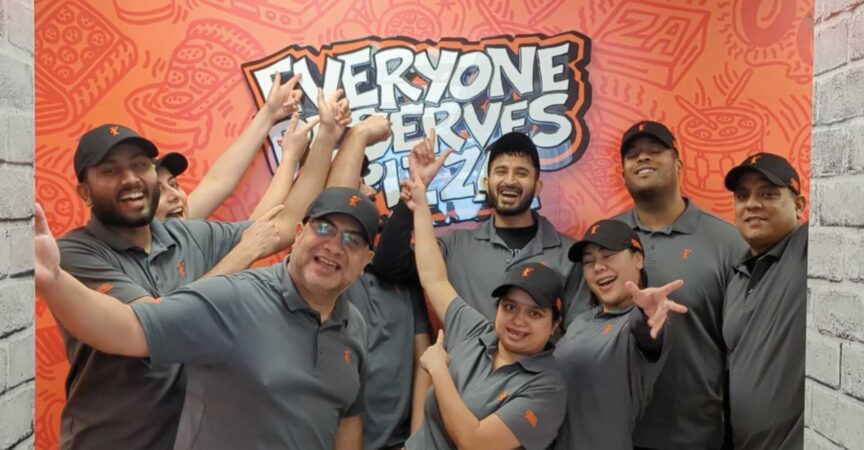
Sheardown says that culture is tangible. “Coming to Pizza Pizza, this is the most hospitable work environment I’ve ever been part of in my career—and it happened in my 35th year in the industry,” he says. The company’s “Everyone Deserves Pizza” philosophy extends that experience across the organization. As Silverstein explains, “From our customers to our corporate team to our vendors, everybody should have a place at Pizza Pizza where they belong.”
Training first has to earn attention and, ultimately, adoption. Silverstein says Pizza Pizza approaches program design with a practical question: “What experience can we create that will engage people and make them want to replicate it in their restaurants?” A separate, recent Dough Lead Training program at the Pizza Pizza Training Centre saw attendance grow across successive sessions throughout the day, until the final class reached capacity as interest increased. “Word of mouth is getting out around how training is different and how people are benefiting from it. Now we have more people who are interested and want to participate.”
The Respect in Restaurants rollout follows the same practical logic. Pizza Pizza expects to begin with live virtual training, then keep the Toolkit available through its e-learning system. Virtual delivery allows the company to reach franchisees and restaurant teams across a geographically diverse network, while providing a consistent learning experience and making the training easy to access and revisit.
The content itself establishes a clear standard of support. “The objective isn’t to train frontline team members to tolerate more,” Silverstein says. “It’s to help them recognize what is happening, use the appropriate techniques where it’s safe to do so, and know when the interaction has moved beyond their role.” She connects that preparation to the operational training restaurants already take seriously. “We train people on food safety, equipment, products and procedures. We think the same thing should apply to challenging guest interactions.”
Sheardown hopes the result is a greater sense of agency. “I hope it gives them a sense of empowerment—that they feel they can keep control of the situation,” he says. “Without the tools, they may feel like the situation is taking control of them.” No resource can script every encounter. The value lies in ensuring employees enter those moments with options, clear boundaries and the support of the organization behind them.
Putting collaboration to work
At the centre of the Toolkit’s adaptation are Grace Bishop, director of training at Pizza Pizza, and Guse Salah. Silverstein credits Bishop more broadly with helping transform the company’s approach to learning from obligation into experience. “She is a true leadership and development director,” Silverstein says. “She understands that how it’s delivered, and the experience you receive when it’s being delivered impacts the result and the engagement around it.”
Bishop and Guse Salah are doing the close editorial and instructional work required to bring the Toolkit to completion. Both have deep training background. CTI’s review provides an important check: concision cannot come at the cost of the source material’s integrity.
Their colleagues are quick to put names to that invisible labour. “Donald and Grace have been absolutely incredible in supporting this initiative with their distinct skill sets,” Sheardown says. “It really was a team effort.” Silverstein adds that the pair have done the work of making the resource “what we envisioned it to be.”
From member need to industry capacity
Hospitality has always had a generous backchannel. Chefs, operators and trainers compare notes across company lines because they understand the work in a way few outsiders can. Sheardown has maintained relationships with peers at competing businesses for decades. This project gives that informal instinct a structure—and a national reach.
“At the end of the day, we succeed as an industry when we work together,” he says. “Even if we are in a competitive industry, it is only going to make things better for everybody.” Silverstein sees a similar choice: treat workforce knowledge as a private advantage or turn it into shared capacity. Collaboration, she says, recognizes “the responsibility we have to invest in people beyond teaching the technical requirements of a role.”
For Restaurants Canada, the Toolkit demonstrates the multiplier effect of the collaboration. A member brought forward a specific operating need. Restaurants Canada was able to connect the need with a specialized training group, structure and staff a development process and will return the result to a far wider group of operators.
“We are responsive to the needs of our members,” Guse Salah says. “If members bring priorities to us, then we can be responsive to those specific priorities as well.” For Pizza Pizza, the experience has also expanded the idea of what association membership can make possible—not simply what Restaurants Canada already offers, but what a member and its association might build together next.
That value is put into action in different ways across Restaurants Canada’s national membership cohort. Once the material is shared, the use case for each restaurant will remain customizable, practical and local. An independent restaurant without a dedicated human resources team may use the Toolkit as a ready-made foundation.
Hospitality has always depended on recognizing what people need and responding with care. In building this Toolkit together, Restaurants Canada and Pizza Pizza have applied that instinct to the benefit of members across the country.