
Holding the Line
A Steady playbook for the year ahead.
by Chris Elliott, Chief Economist & VP, Research, Restaurants Canada
I’m not going to pretend there’s something magical about the calendar turning over—restaurant owners are frankly exhausted with “fresh start” narratives. Most have been operating in survival mode for years—absorbing cost shocks, rebuilding teams, adapting to shifting consumer behaviour, and doing it all while trying to protect their standards and their sanity.
What operators could use is a clear-eyed read on what’s coming, and a practical set of moves that can help them stay stable—financially, operationally, and emotionally—through a year that’s shaping up to be pivotal.
After a surprisingly strong 2025, 2026 will likely feel different. Canadian consumers proved far more resilient than expected last year, buoyed by a wave of patriotic spending and a sharp increase in domestic travel. One of the biggest drivers of that surge was a 30 per cent decline in the number of Canadians travelling to the United States.
The result was a meaningful boost to foodservice sales, which rose by six per cent or more in six of the first nine months of 2025. That performance is remarkable given the broader macroeconomic climate: a trade war that has pushed consumer confidence to its lowest level since the Conference Board of Canada began tracking the data in 2002, and an ongoing affordability crisis. According to a recent Angus Reid survey, nearly eight in ten Canadians have cut back on non-essential spending in an effort to save money.
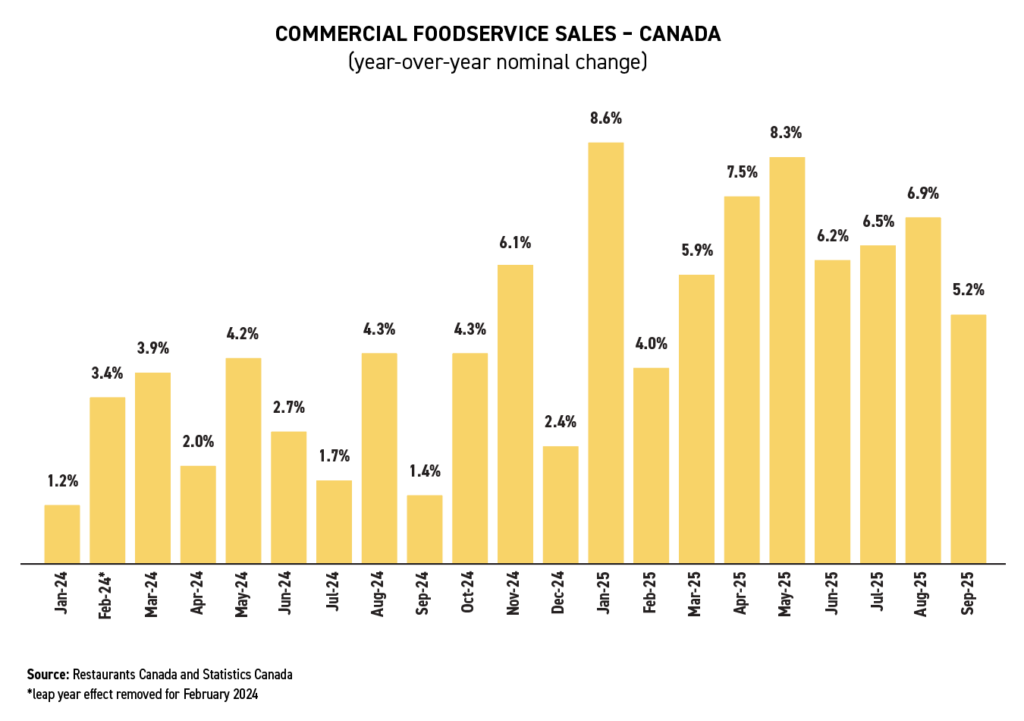
Yet restaurant spending can only defy gravity for so long. Many of the forces that propelled foodservice sales in 2025—such as the GST/HST holiday and the surge in domestic tourism—won’t be here in 2026. Population growth, which also provided a meaningful lift to demand in recent years, is expected to stall. Against that backdrop, it will be difficult for the industry to match last year’s robust sales growth rates in the current economic climate.
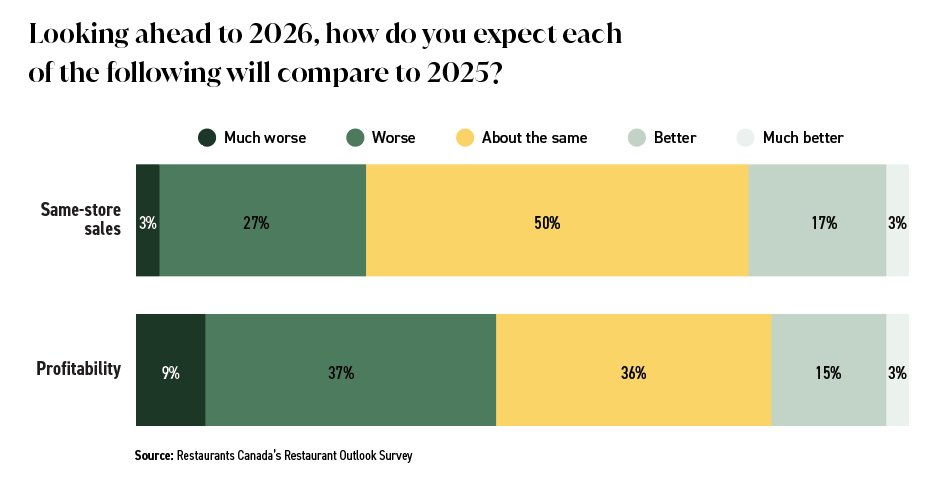
Operators see this coming and are bracing for a tougher year ahead. Our latest Restaurant Outlook Survey shows that 30 per cent of operators expect same-store sales to be worse in 2026 than in 2025, compared with just 20 per cent who expect an improvement. More concerning, nearly half of respondents anticipate lower profits. In an industry already operating on razor-thin margins, any further erosion could trigger a wave of business closures.
So rather than delivering a pep talk, I want to offer something more useful: five priorities that can help restaurants protect what they’ve built—and make decisions with a little more control, even in a volatile year.

Priority 1: Treat labour planning as risk management.
With labour shortages still affecting service levels—and wages now a much larger share of operating costs—labour planning in 2026 needs to be treated as a risk management strategy, not just an HR function. In an environment where replacing an employee is both costly and time-consuming, retention is often the most effective way to protect margins and maintain consistency for guests.
Simple, intentional steps can make a meaningful difference. Predictable scheduling, clear paths for advancement, and regular feedback go a long way in keeping teams engaged and reducing unnecessary turnover.
Practical actions operators can take include:
- Auditing scheduling and staffing patterns to improve predictability and fairness.
- Investing in cross-training and upskilling to increase flexibility and reduce burnout.
- Implementing stay interviews, not just exit interviews, to identify issues before employees walk out the door.
Several restaurant companies are already demonstrating how thoughtful labour strategies can support both
retention and performance. Chipotle, for example, has invested heavily in in-person, “shoulder-to-shoulder”
training, helping new hires build confidence quickly and feel connected to their teams. The company also
emphasizes internal career pathways, with many managers and senior leaders having started as hourly crew. Beyond wages, Chipotle offers well-being supports, including a healthcare concierge to help employees navigate mental health services—recognizing that retention is influenced by more than pay alone.
Other operators are taking similar approaches. Some national and regional chains have expanded cross-training programs to allow staff to move between roles, improving schedule stability while creating
development opportunities. Others have introduced more transparent promotion criteria and structured
training milestones, giving employees a clearer sense of what progression looks like within the organization. A growing number of operators are also experimenting with more predictable scheduling practices, acknowledging that work-life balance is increasingly important in attracting and retaining staff.
Managing labour costs while keeping teams engaged will be critically important in the year ahead. For many operators, the most achievable gains in 2026 won’t come from cutting hours or chasing constant hiring—but from building a more stable, motivated workforce that can carry the business through a challenging year.

Priority 2: Watch expenses like a real-time dashboard.
Over the last two years, restaurants have faced double-digit increases in costs—from food and labour to rent, utilities, and insurance. But we’ve reached a tipping point: operators can’t keep passing these higher costs on to guests. As one owner told us, “We’re seeing fewer visits and rising costs, with no room to raise menu prices.”
Our surveys show how operators are responding:
- 53% are changing suppliers
- 50% are streamlining menus
- 32% are reducing operating hours
Even small adjustments—like revising portions or removing low-selling items—can have a disproportionate impact on profitability. Benchmarking performance can also highlight where efficiencies can be gained. Restaurants Canada members can access the Operations Report on the Member Portal to see how their business compares and identify areas for improvement.
The key takeaway: controlling costs requires vigilance. Regularly reviewing expenses, testing small changes, and understanding performance metrics can make the difference between staying profitable or falling behind in 2026.
Priority 3: Deliver unmistakeable value through guest experience.
With economic uncertainty expected to persist through 2026—particularly given the lack of a U.S. trade deal—consumers will remain cautious about discretionary spending. People are more likely to dine out when the experience feels special, consistent, and worth it. That’s where the “value equation” comes in: guests weigh price against quality, service and atmosphere.
In a competitive market, loyalty hinges on memorable experiences. Operators can make meaningful improvements by:
- Training staff to provide consistent, attentive service.
- Listening to and acting on guest feedback.
- Making small, targeted enhancements to ambiance or service flow.
Even minor changes—like improving lighting, optimizing table layouts, or refining order accuracy—
can transform the guest experience. A welcoming, reliable atmosphere encourages repeat visits, positive reviews, and word-of-mouth referrals, which are critical in a tighter economy.

Priority 4: Reduce friction with thoughtful technology.
Technology can be a gamechanger for restaurants, helping reduce labour strain, capture better data, and improve operational speed. But the key isn’t adopting every new platform—it’s choosing the right tools that deliver tangible benefits.
- Well-selected technology can:
- Reduce errors and manual work.
- Streamline routine tasks.
- Provide actionable insights for better decision-making.
- Enhance convenience for both staff and guests.
The best approach is thoughtful integration. Digital tools should simplify operations without overwhelming teams. Examples include automated inventory tracking, online ordering systems that sync with the kitchen, or scheduling platforms that reduce last-minute staffing headaches. When used strategically, technology becomes a force multiplier, helping operators run leaner, smarter,
and more efficiently in 2026.
Priority 5: Strengthen community ties that drive loyalty.
Restaurants that actively engage with their communities build loyalty and gain a local edge. One example I heard about recently concerned the U.S.-based, fast casual chain CAVA, which has grown successfully even as other chains struggled. A key factor in their success is a genuine commitment to community—beyond branding—delivered in real, mission-driven ways.
Some of the initiatives CAVA has implemented include:
- Community Days: When opening a new restaurant, CAVA hosts events with free meals and donations to local nonprofits, often in underserved neighborhoods.
- Food Bank Partnerships: The chain collaborates with food banks to serve meals to those in need.
- Reducing Food Waste: Pilot programs in nearly 50 restaurants with Too Good To Go redirect surplus food to customers, helping reduce waste.
- Paid Community Leave: Hourly employees receive two paid days annually to volunteer or participate
in activism.
Canadian operators don’t need to replicate these programs to see benefits. Even small, authentic acts of engagement—like supporting a local charity, hosting a community event, or volunteering with staff—can foster stronger guest loyalty and boost local brand recognition. The principle is simple: when a restaurant demonstrates it cares about the people and neighborhoods it serves, customers notice, remember and return.
The Takeaway: It’s all about staying steady.
If 2026 is a tougher year, the answer isn’t a grand reset. It’s a set of practical operating habits that protect what matters: your people, your costs, your guest experience, your systems, and your place in the community.
The principles are familiar, but they’re worth stating plainly—especially in a year where energy and bandwidth are limited:
- Set specific, manageable, actionable goals rather than vague ambitions.
- Avoid taking on too many changes at once, which can lead to burnout.
- Treat improvements as small habits or routines—not “big transformations”—so they’re more likely to stick.
2026 will undoubtedly be challenging. But by staying steady on the fundamentals—labour, costs, guest experience, technology, and community engagement—restaurants can do more than protect profitability in the short term. They can build the kind of control and predictability that’s been in short supply for years: more stable teams, clearer cost visibility, tighter systems, and a more reliable guest value proposition. Those gains compound. And when the storm clouds eventually clear, the operators who used this period to strengthen their fundamentals won’t just be relieved—they’ll be positioned to grow with confidence.