The Rooms Rebuilding Foodservice
Foodservice has always been powered by people, and today, there’s a growing focus on designing spaces that better support and empower them. In the first quarter of the year, the industry saw a series of gatherings that felt less like events and more like modern salons: spaces for exchange, visibility and real professional momentum.
Community has long been at the heart of hospitality, and the industry is now more intentionally integrating it into how we approach hiring, retention, and growth. Events are becoming more purposeful in creating environments where connection and opportunity can truly take shape. A new generation of community-driven gatherings is placing practical support structures at the centre of the program, making career pathways more visible and bringing meaningful relationships and business opportunities more clearly within reach.
This shift from passive attendance to active participation matters because these rooms are being designed to produce tangible value. People are not showing up simply to sit at a table and listen to a speaker over expertly catered plates. They are arriving ready to be seen, to connect, to ask better questions, to pursue opportunity and to share insight with others.
What gives these gatherings particular force is the generosity they make possible: a willingness to open doors, share knowledge and make the room more useful for someone else. At a time when foodservice and hospitality are continuing to strengthen talent pipelines, improve retention, and create clearer pathways for advancement, this matters. These gatherings help make the industry more visible, more navigable and more useful to the people trying to build a future within it. They create visibility around talent and connect peers and leaders in ways that feel immediate, practical and genuinely valuable.
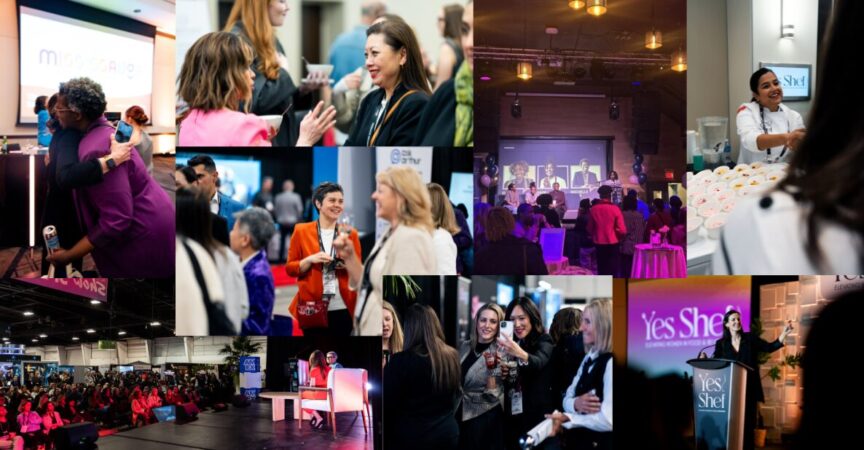
There is a profound difference between an industry that people merely move through and one that invites them to build a meaningful career. Gatherings like these help bridge that divide by making the architecture of opportunity more visible, showing how growth, mentorship and momentum actually happen. That is why recent events like Yes Shef, Hire Her, Too and dish. matter beyond their programming. They are not simply reflecting the industry back to itself. They are helping shape the conditions under which it can become stronger, more connected and more durable.
Yes Shef
The first Greater Toronto Area edition of Yes Shef, held on March 9 alongside RC Show 2026 at The International Centre in Mississauga, offered a strong example of what community can do when mentorship and connection are built into an event’s design.
Founded by the WORTH Association in Vancouver as a long-table dinner, Yes Shef was created not only to celebrate women in foodservice, but to connect acclaimed chefs with women studying culinary arts through mentorship, visibility and shared experience. It has since grown into one of Vancouver’s most resonant hospitality gatherings, hosting more than 1,000 guests and helping fund scholarships for emerging talent.
Yes Shef intentionally brings established women leaders and early-career talent into the same room, helping close a gap in an industry where mentorship has not always been formalized or readily accessible. Seeing women lead, teach and connect in real time shifts perception in a way panels alone rarely can. The impact is also designed to last: the Toronto event saw $15,000 in scholarships awarded, 15 mentorship pairings created, and 100 per cent of proceeds directed to support women in recreation, tourism and hospitality.
Hire Her, Too
Hire Her, Too, presented by The Re-Seasoning Coalition and High Liner Foods on March 24 at Revival in Toronto, showed what can happen when an industry gathering is designed with a clear structural purpose.
The Re-Seasoning Coalition’s work is rooted in expanding visibility, access and leadership pathways for Black talent in hospitality. This event brought that mission into sharp focus by placing Black women front and centre and building the format around one clear objective: creating real pathways to opportunity.
Nothing about their event felt generic. From résumé screening and complimentary headshots to honorariums that helped cover childcare and travel, every detail was designed to remove barriers and make support feel immediate and practical. More importantly, the event pushed beyond conversation into accountability, leaving attendees with concrete calls to action and a clearer sense of the work to be done.
If three in ten Black women in foodservice are seeking stable, long-term careers, yet remain in the industry for an average of just six years, the issue is not ambition. It is whether access, support and opportunity are built into the success equation. Hire Her, Too made a compelling case that they not only can be, but must be.
dish. Networking Reception
RC Show is dynamic, expansive and full of energy with facilitation for the kind of conversation that builds lasting relationships. The dish. networking reception at RC Show 2026 on March 9 showed the value of creating intimacy inside an event built on a full scale. It made space for the right mix of operators, partners and industry leaders to connect in a more intentional setting, where conversation could feel less incidental and more meaningful.
What emerged was not just a good room, but a useful one: a space to meet with more focus, reconnect more naturally and build relationships with more substance than the trade show floor typically allows. That balance — between the momentum of the larger event and the intimacy of a smaller gathering — made the reception feel like a deliberately useful counterpoint to the trade show floor around it.
With greater focus on attraction, inclusion, and retention, the industry is recognizing what has always been at its core: hospitality is not just a workplace, but a community of practice. If foodservice is going to grow in ways that are sophisticated, more inclusive and more resilient, it needs purpose-driven spaces that create real connection, deepen community and open the door to opportunity.
That shift, reflected in these recent events, matters. But it will not gain momentum through operations alone. It will gain momentum when we treat community-building as part of the work itself, and when we all play a role in helping foodservice communities flourish as serious professional resources.