
The Ledger: Finance Matters for Restaurants

Cash Isn’t Going Anywhere
In foodservice, it’s easy to assume Canada has moved on from cash—until the POS goes down, the internet drops, or a guest pays the way they always have. Cash still matters because it’s simple, widely accepted, and reliable when systems fail. That’s why the Bank of Canada continues to issue and protect banknotes: designing them with security features that can be checked quickly at the point of sale and providing training, so cash handlers know what to look for.
For operators, the stakes are practical and immediate. The Bank will not reimburse a counterfeit note, and once a fake bill is accepted, the loss—and any liability tied to how it’s handled—can become an expensive lesson.
OPERATORS STILL NEED CASH.
In a December 2025 address to the Chamber of Commerce of Metropolitan Montreal, Bank of Canada governor Tiff Macklem emphasized that even as digital payments surge, cash remains widely used across the economy: “About 80 per cent of Canadians—perhaps surprisingly, both old and young—and 96 per cent of small- and medium-sized businesses use cash.” That continued reliance on banknotes shows up at the point of sale, too. Anna Hardy, Senior Regional Representative at the Bank of Canada, notes that cash is still moving through the economy at a scale operators can’t ignore. “The bank does survey Canadians about their cash usage and right now, about one in five transactions is done in cash,” she says. And wherever cash remains in circulation, the risk follows: “Counterfeiting is still comparatively low, but we are seeing small increases across the country.”
For restaurant and retail operators, cash is not just nostalgia—it’s continuity. Hardy’s case for cash is practical and rooted in service realities. “Cash is simple; it’s widely accepted,” she says. “It’s accessible and inexpensive to use, and it’s the only form of payment that’s 100 per cent reliable. You can use it during power outages, and without vulnerability to cyber attack.”
Hardy defines the cash vs. digital payment debate as really not much of a debate at all, noting that cash isn’t competing with digital payments, but filling the gaps digital transactions can’t always cover. “Cash is also essential and inclusive,” Hardy emphasizes. “In Bank of Canada surveys, most Canadians say they have no plans to go cashless in the next five years. Also, places with lower levels of Internet connectivity typically rely on cash more often. For example, I recently visited an island off the coast of BC that has a candy store. The owner only accepts cash because her Internet cuts out so often she can’t reliably accept electronic payments.”
COUNTERFEIT RISK TO OPERATORS IS REAL.
The reason counterfeit risk matters to operators isn’t simply that fakes exist—it’s
who ultimately pays for them. “There is no central bank in the world that will reimburse somebody for a counterfeit bill,” Hardy says. “That’s why, even with the highly engineered polymer notes the Bank produces, the burden still falls on the business to protect itself during the transaction. And in sectors with tight margins, the cost of a single mistake can be outsized.”
To put the risk in operator terms, Hardy references a Statistics Canada profit-margin figure for a broad retail grouping (grocery, convenience, food retailers, and alcohol retailers) showing margins of roughly five per cent in 2024—thin enough that a single counterfeit note becomes a sales-recovery problem. At a five per cent margin, every $1 in sales generates about five cents in profit. So, if a business takes a $100 counterfeit bill, that $100 is effectively a direct loss. “Bearing the cost of counterfeit is tough, and especially in industries with narrow profit margins,” Hardy points out. “So, to put that example in perspective, you would have to sell about $2,000-worth of goods to recoup a loss incurred through a single $100 counterfeit banknote.”

WHAT OPERATORS MUST DO IF THEY SUSPECT A BANK NOTE IS COUNTERFEIT.
The second a suspicious banknote is found;the operator’s responsibility is straightforward: turn it over to police—either local police or the RCMP. From there, the police will process it and send it to the National Anti-Counterfeiting Bureau (NACB), an RCMP office in Ottawa that acts as the central repository for counterfeit currency recovered in Canada, including Canadian notes, U.S. currency, and other currencies.
Hardy emphasizes that the process is designed to take further burden off the business once a note is in hand because not every “off” note is actually counterfeit; sometimes a bill is simply worn out, damaged, or low quality, and the NACB can confirm whether it’s genuine.
If the note is genuine, it will be returned to the business; if it’s counterfeit, police determine next steps for investigation, which may include requesting video footage or other
details related to the person who passed the bill. Hardy also clarifies the Bank of Canada’s role in this chain: “The Bank’s role is to produce the notes that are highly secure against counterfeiting,” she says, “and then train and educate people on how to check those security features. We also work with law enforcement to support them in their investigations.”
“BANKNOTES ARE ONLY SECURE IF YOU CHECK THEM.”
The Bank of Canada’s central message to businesses is straightforward—and operator-facing. “We can make the most secure bank notes in the world, but that doesn’t matter if people don’t take the time to check them,” Hardy says. “It only takes a few seconds to check a bank note, and they are all designed to be checked without any special equipment by anyone, anytime and anywhere.
Hardy weighs the value of training restaurant teams to make checking for counterfeit bank notes an operational habit against the cost of failing to do it, and it’s a no-brainer. she says. “So, taking a few seconds to look, feel and flip is pretty important.”
And for any business tempted to “move it along” once a bill is recognized as suspicious, she’s equally clear: “Knowingly passing a counterfeit bill is a criminal offence.”
FEEL, LOOK, FLIP: A PROCESS THAT SURVIVES A RUSH.
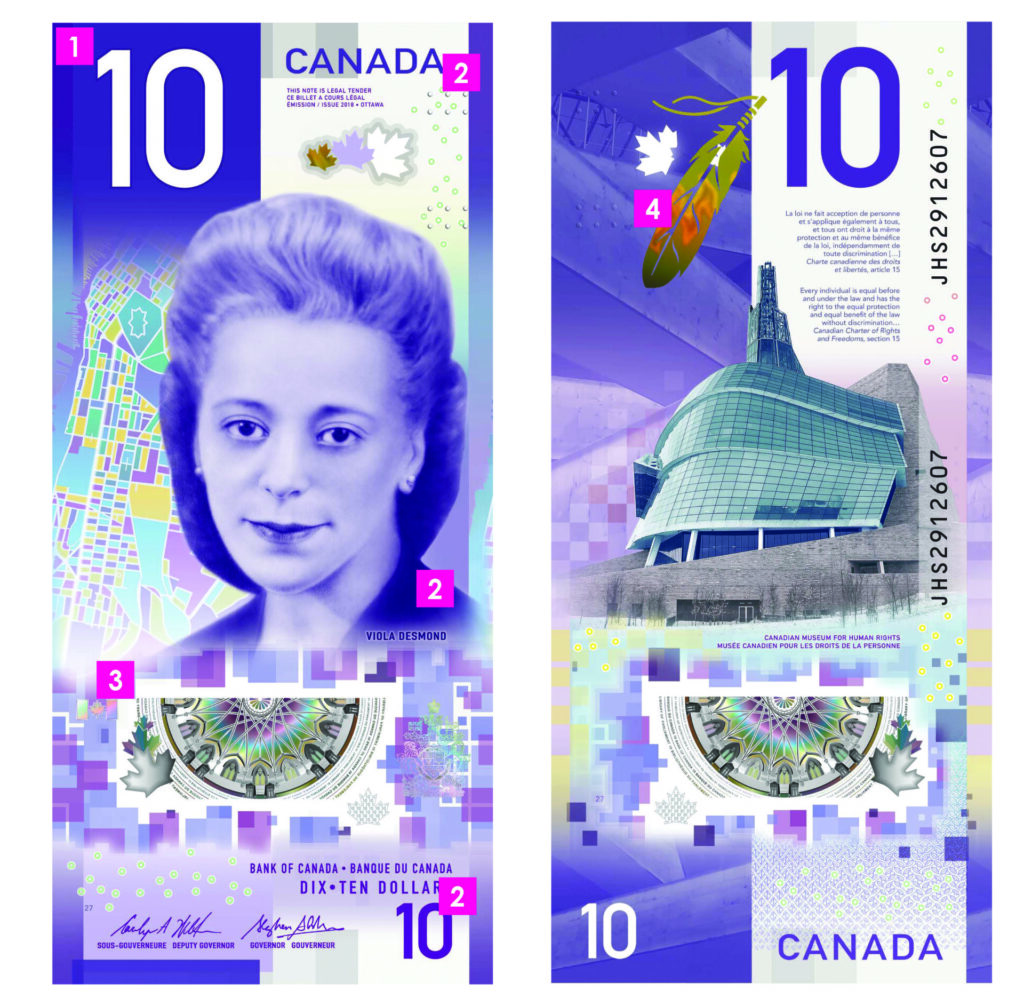
The Bank’s recommended method is designed to work in a real service environment—fast, repeatable, and trainable, taking just a few seconds to complete. “Once you know what you’re looking for it’s really easy to check,” Hardy says, pointing out that the Feel, Look, Flip slogan is a mnemonic device to make it easy to remember the process. “First, you want to feel the smooth texture of the polymer and then the areas with the raised ink. Next, you want to look through the transparent windows and then the details and the metallic images.” Finally, you flip the note over and look for the metallic images repeated on the back of the note.”
Crucially, she points out that experienced front-line staff often have an intuitive advantage because of repetition. “Our brains are wired on pattern recognition,” Hardy says, and “generally servers would handle enough cash to know when something feels ‘off’. It’s helpful to remember to look for differences rather than similarities, so compare the note to a note that you know is genuine and you should be able to tell pretty quickly whether or not the note in question is counterfeit.”
THE MISTAKE COUNTERFEITERS COUNT ON.
If there’s one operational pattern Hardy sees again and again, it’s selective checking. “The most common mistake is only checking larger denominations like $50 or $100 bills,” she shares. “Counterfeiters know that $100 bills will face more scrutiny, so they often work with smaller denominations like fives or twenties because they think that cash handlers won’t see a five- or a twenty-dollar bill as a threat. You should check all your notes.”
Hardy also counsels caution for small business owners who may hear about an uptick in counterfeit activity on the news. “When there is a media report, some retailers will stop accepting $100 bills,” she says. “I wouldn’t recommend that approach because it may give you a false sense of security—it actually doesn’t make you any less vulnerable.”
DECLINING A NOTE SAFELY, WITHOUT ESCALATING THE SITUATION OR OFFENDING A GUEST.
For operators, the most delicate moment is the face-to-face refusal. Hardy’s advice prioritizes staff safety and internal policy, encouraging operators and staff to follow their internal
procedures—without putting themselves or their staff at risk. Hardy also acknowledges that not everyone holding a counterfeit note is doing so knowingly. “It is possible that the person in possession of the bill is just an innocent victim,” she says. “They may have no idea it’s counterfeit.”
For these reasons, Hardy suggests a simple, polite script: “I’m sorry. This note looks like it might not be genuine, and you might want to check it with police. I’d be happy to take another note or a different form of payment instead.”
THE FUTURE INCLUDES CASH, AND NEW NOTES ARE ON THE WAY.
Even as payment technologies evolve, the Bank of Canada anticipates a continued role for cash. “We know that the future has cash in it and that means that counterfeiting will also be part of the future,” Hardy says. “We are issuing a new, vertical $20 bank note next year featuring King Charles III, and it will include the latest, state-of-the-art security features. Following that, we’re going to be issuing a new $5 bill featuring Terry Fox.”
Hardy also points to a shift operators may have noticed over time: rather than issuing banknotes in full series—as with the Birds of Canada series (1986–2001) and the Frontier series (2011–2013), the first polymer series—the Bank of Canada now releases notes one denomination at a time to stay current with evolving security threats. The practical implication is straightforward: new security features aren’t retrofitted into older notes. Instead, updated denominations enter circulation gradually, and older notes are steadily withdrawn and replaced as they cycle out of use.
MAKE THE CHECK VISIBLE AND ROUTINE.
Canada’s banknotes are designed with security in mind—but that security only works if it’s used at the point of sale. Hardy’s advice is simple: train yourself, train your staff, and make “feel, look, and flip” a visible, everyday habit. When customers see that you check notes as a matter of routine, it becomes normal—and a few seconds of attention can prevent a loss you’ll have to work hard to earn back.
“Just take a second to feel, look, and flip so you don’t get more than you bargained for,” says Hardy. “Most people think it’s pretty fun to look at money in a different way than they may have in the past.”
Staff Guide: How to Politely Refuse a Suspicious Note
Courtesy of Anna Hardy, Senior Regional Representative, Bank of Canada.
I’m sorry. This note looks like it might not be genuine, and you might want to check it with police. I’d be happy to take another note or a different form of payment instead.”
Even if you decline the note, she says it’s still useful to inform local police about a possible attempt to pass suspected counterfeit cash. “Local police services will be tracking the trends in your area. The more people check notes and report, the more it’s normalized, and then the more the process protects everyone.”

Mistakes can be costly, but Bank of Canada’s training is free.
Build counterfeit checks into your daily routine with free Bank of Canada retailer resources or training. Book a short virtual session for your team (as little as 20 minutes), schedule it around any shift, or use the online tools—staff handbook and quiz—for quick, consistent onboarding.
To request training or materials, visit: bankofcanada.ca
Or contact the Bank of Canada directly to request training materials or a virtual session at: T: 1-800-303-1282
Training and materials are available in English and French and can be tailored to your region and business setting.