
Black Leadership à La Carte
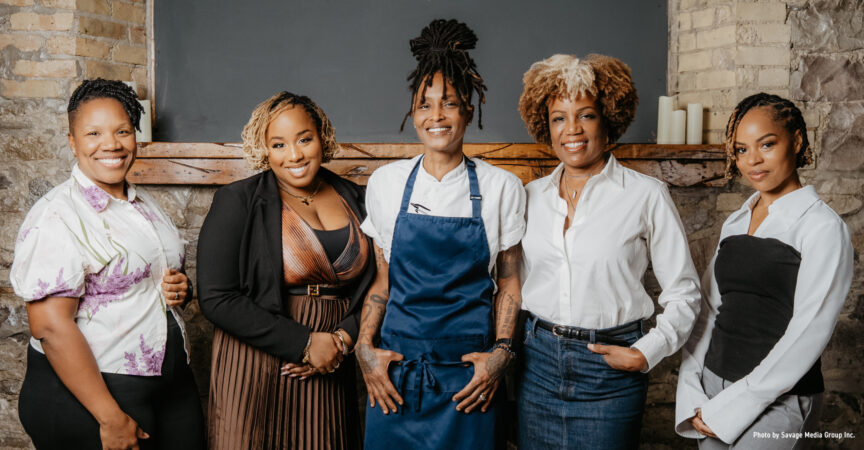
A new leadership series spotlighting seven Black women shaping foodservice beyond the front line.
The Re-Seasoning Coalition (TRSC) conceived Black Leadership à la Carte with a clear and deliberate purpose. Funded by Women and Gender Equality Canada (WAGE), the series set out to shine a light on the many career pathways available to Black women in foodservice and hospitality—paths that extend far beyond the industry’s most visible positions of cooks and servers. It was designed to surface leaders working in operations, marketing, people and culture, entrepreneurship, brand management, and more—roles that shape the industry just as profoundly yet are not always clearly recognized as opportunities.
What emerged in the process of building the series, however, revealed something deeper than a gap in visibility. It exposed how systemic exclusion, self-protection, and imposter syndrome continue to influence who steps forward when the spotlight appears—and who hesitates, even when they are eminently qualified to stand in it.
“The subjects featured in this series required a months-long search,” says Elle Asiedu, Co-Founder and Executive Director of TRSC, detailing outreach that extended beyond her own network to include industry referrals, LinkedIn research, and the support of a hospitality recruitment professional.
Some participants were identified through foodservice decision-makers who knew their impact firsthand. “Others were found at non-foodservice events where they were being celebrated for having made it through the challenges that come with being Black and ambitious,” Asiedu recalls. “That’s an achievement in and of itself.”
Even once identified, a candidate’s participation was far from guaranteed. Several women declined because they believed the outreach might be a scam. Not out of cynicism, but out of lived experience. The idea that Black women leaders in foodservice would be intentionally sought out, centred, and celebrated felt unfamiliar—almost implausible. For some, being called up and celebrated was unexpected enough to invite doubt.
That doubt has context.
Asiedu recalls an early-career experience presenting departmental progress to her organization—highlighting not only her own results but the achievements of her team—only to be publicly undercut by her non-Black manager: “Why are your numbers there? Do you want us to clap for you?”
The reaction wasn’t about data, format, or professionalism. “It was because I was a Black manager. And more importantly, the only Black woman in the office,” Asiedu notes. “A great leader and an easy target. These are the dispiriting realities that come with being one of one or one of a few, in any industry. I realized my wins were best enjoyed in silence or not at all.”
That kind of humiliation may feel painfully familiar to many women in the workplace. But for Black women, it’s layered with racism, amplified by being “a unicorn” in the room, and shadowed by stereotypes that cast confidence as arrogance and self-advocacy as a threat. These experiences don’t just sting in the moment or even years later, they quietly teach you that standing in your accomplishments can be dangerous, and shape how—and whether—leaders choose to be seen.
Black Leadership À La Carte was built first and foremost as a platform to show other Black women that their leadership in foodservice and hospitality deserves to be seen, nurtured, and celebrated—a direct challenge to that reality. “As the architect of this series, I’ve turned the spotlight on Black women at the top and on their way up, persuading them to join me in applauding their resilience,” Asiedu explains. “To become possibility models for others and the industry overall.”
The invitation is intentional, but it is not neutral. Visibility carries risk when history has shown that being seen does not always translate into being supported.
Imposter syndrome, too, plays a powerful role. For leaders who have rarely seen themselves celebrated in senior or non-traditional roles, doubt can creep in even alongside achievement. “Increased representation is still required,” Asiedu reminds us. “Even in 2026, the push for it comes from decades—and often, generations—of being unsure whether someone with your identity, your name, or your hair texture will be given the same grace and the same opportunities to thrive.”
None of this would exist without the Black women leaders who said yes. The women featured in Black Leadership à la Carte trusted TRSC with their stories, their lived realities, and their hard-won lessons—and in doing so, they modelled what it looks like to claim space. Whether they sit in operations, marketing, people and culture, brand management, entrepreneurship, or other roles that keep this sector moving, each one chose to step into the light not just for themselves, but for the Black women coming up behind them. Their courage, candour, and brilliance are a powerful reminder that when we make room for Black women’s leadership, the entire industry moves forward.
And it leaves the industry with a critical challenge.
For leaders committed to advancing diversity, equity, and inclusion, this series is a reminder that talent does not always announce itself. There may be Black women—or other team members from equity-denied groups—who do not step forward when new opportunities arise. Not because they lack ambition or readiness, but because experience has taught them caution. They are already driving results, creating efficiencies, and leading without being recognized, fairly compensated, or invited into formal leadership. It is the responsibility of those in power to actively look for these contributions, address pay and promotion gaps and root out racism and bias in their organizations.
Everyone in the industry has a role to play in recognizing and elevating Black leadership and potential within their organizations. For readers who are not Black women, Asiedu calls for reflection, urging leaders to examine the moments when Black women might be dismissed for not having “the right look,” when they are not given opportunities because personal connections are favoured over skills and experience, or when the racism they experience is minimized as a guest or a colleague “having a bad day.” Recognize who is trying to get in the room or restaurant, but can’t. Consider whose stories, presence, or voice at the table are likely to be silenced or not taken seriously because they don’t represent the majority. Take action when you realize that someone’s safety is being sacrificed to allow others to be comfortable. These are the demands required of modern, equity-informed leadership.
Leadership potential often shows up quietly: in the colleague others turn to for help and clarity, in the team member who defuses moments of tension, in the person who consistently adds value, but is not given the same in return. Some of the strongest emerging leaders may never directly ask for the next opportunity. It is up to organizations to learn how to recognize these signals, and to create environments where stepping into the spotlight feels safe, supported, and worthwhile.
Until that becomes the norm, the work of turning on the light remains essential.

Build a workplace where all talent thrives—and stays.
Learn more and enrol in TRSC’s e-learning program: Equity & Empowerment in Foodservice: thereseasoning.org